
About a ten-minute read.
You’ve read the legal alerts by now, so this isn’t another one. Three questions instead:
1. How does a US$100m trust end up with a US$20.2m tax bill?
2. Why a second passport may not make you a non-resident of China?
3. Where do families with messy records actually overpay?
There’s a checklist at the end, and still time to work through it.
Does this apply to you? Three quick tests. If the settlor was a Chinese tax resident when assets went into the trust, yes. If any beneficiary is a Chinese tax resident and receives anything, including benefits in kind, yes. If someone in the structure holds foreign status but keeps their main economic interests in mainland China, probably — and that is the question worth answering first.
Picture a family office in Hong Kong on the morning of July 25.
The client alerts had landed overnight — Han Kun, KPMG, Morgan Lewis, all of them. By the weekend they had a decent view of where the structure was exposed. The legal questions are hard, but they are the kind of hard senior advisors are paid to resolve, and they were already being resolved.
Then someone asked a question and the room went quiet.
The Hong Kong-listed position we put in back in March 2023 — what did we actually pay for it?
Nobody knew. The custodian had changed twice, and there was a broker transfer somewhere in 2024. The answer existed in principle, sitting in two banks and somebody’s inbox, in three different statement formats.
That question, not the legal one, is what makes these 90 days hard.
1. The tax now follows the whole life of the trust
On July 24, 2026, the Ministry of Finance and the State Taxation Administration issued Announcement No. 21, effective the same day. It is the first set of rules written specifically for how offshore trusts are taxed in China. The old assumption was that tax could wait until money came out. Now every event in the trust’s life — funding it, holding it, paying out of it, winding it up — is its own filing and its own calculation, at a flat 20%.
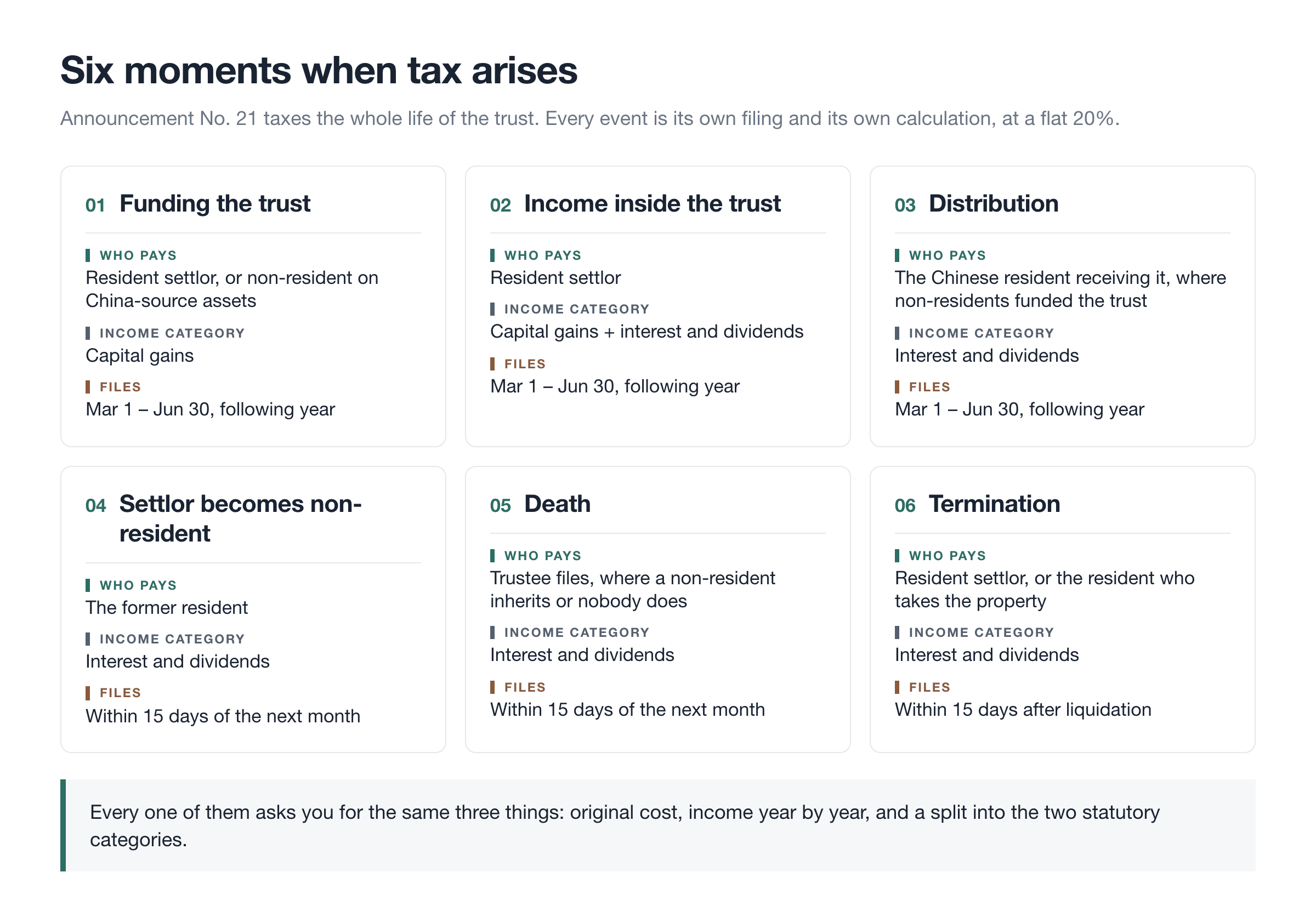
The provision that catches people: income earned inside the trust is attributed to the settlor and taxed every year, whether or not a cent reaches anyone.
There is also a 90-day window to clean up history going back to January 1, 2023. The announcement says “within 90 days from the date this announcement takes effect,” and waives late-payment surcharges inside it. Nothing in the announcement limits what the authorities may look at outside that window, so where amounts are large it would be unwise to treat 2023 as a hard floor.
No closing date is actually stated. Count July 24 as day one and you land on October 21; start the clock the next day and you get October 22. Both readings are circulating. Work to October 21 internally and have your advisor confirm it.
2. First hurdle: you may not be a non-resident
The first reaction is usually: I’ve got foreign status, this can’t apply to me.
It often does.
The announcement is explicit. Someone who has taken foreign nationality, or long-term or permanent residence abroad, but whose main economic interests still sit in mainland China, can be treated as domiciled there, and therefore resident. The 183-day test and the domicile test both survive. What’s new is an additional way to land on the domicile side of the line. A passport, or even a cancelled household registration, doesn’t settle the question.
This bites hardest for Hong Kong and Taiwan business owners and red-chip founders. Status abroad, but assets, income, family and control still anchored on the mainland. If you also qualify as a tax resident somewhere else, the tie-breaker in the relevant treaty becomes the next question — and often the more promising one.
Which way it goes is a question for your lawyer. But arguing it either way takes the same raw material: a complete record of assets and cash flows that traces back to source and holds up under cross-checking. Where your economic centre of gravity sits isn’t something you assert. It’s something you evidence. And if the answer comes back “resident,” here is what the bill looks like.
3. One trust, five events, US$20.2m
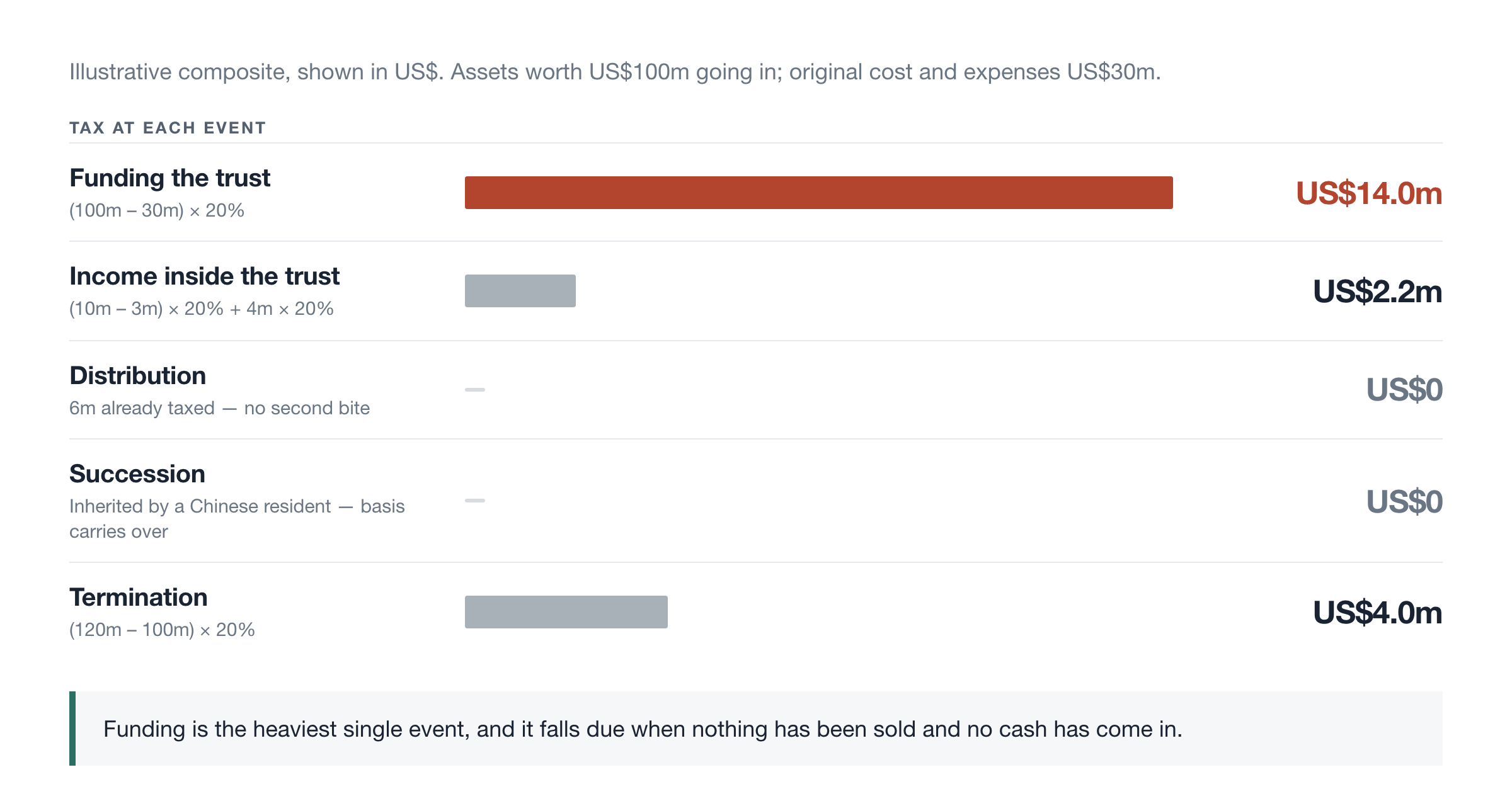
Shown in US$ because that is how most families think about their balance sheet. The filing itself is in RMB, converted at the applicable rate — which is its own piece of work, and one of the items on the checklist below. The example also assumes income arising inside the trust was distributed rather than retained, so it does not add to basis.
Funding is the heaviest single event, and it falls due when nothing has been sold and no cash has come in. It also doesn’t qualify for the five-year instalment relief. That relief is available on termination, and on a resident becoming a non-resident, but not on funding. You need the cash up front, which for most families is a board-level decision in itself.
Income inside the trust is taxed in two buckets that can’t be netted against each other, and trustee, management, legal and advisory fees aren’t deductible. Distributions aren’t taxed twice — as long as you can show the income was already taxed on the way through.
A change of status is a different scenario:
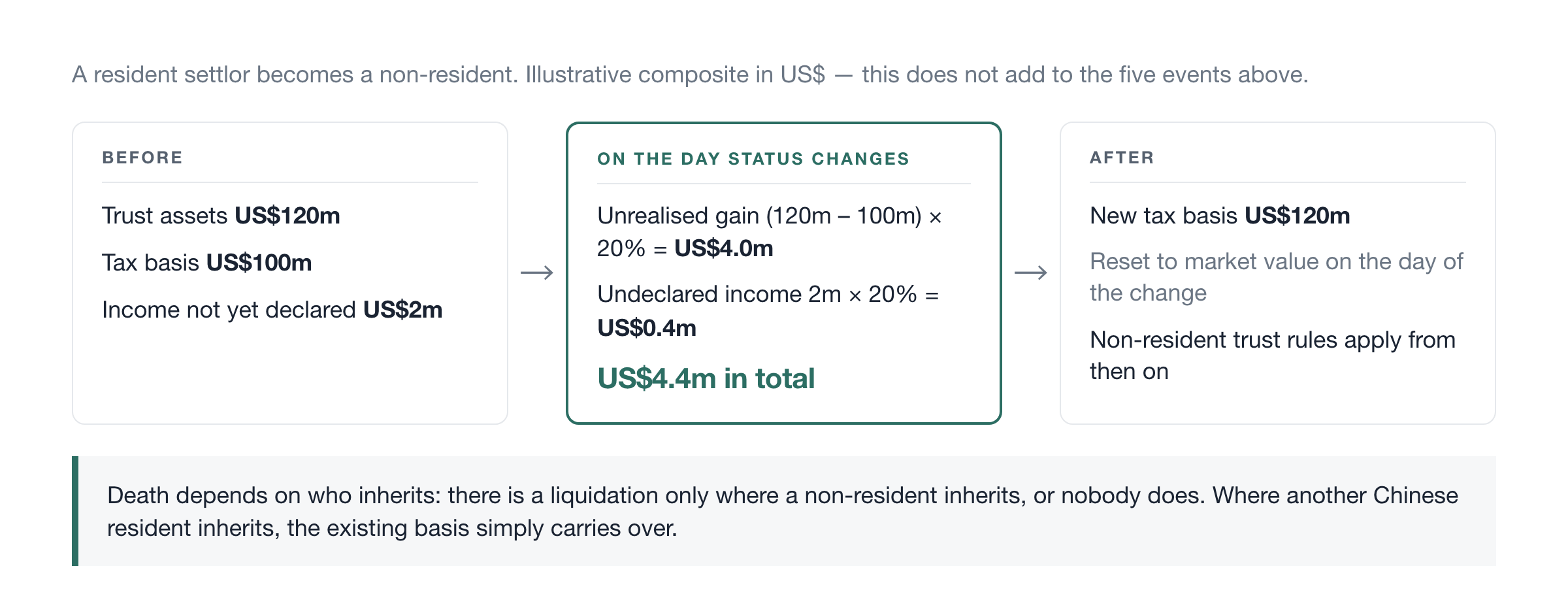
Becoming a non-resident, and winding up the trust, both trigger a deemed liquidation on gains you never realised. Death depends on who inherits: a liquidation only where a non-resident inherits or nobody does. People call this a quasi-estate tax, which is close enough — though China has not introduced one, and the mechanism is a liquidation, not a levy on the estate.
4. Every one of those numbers comes out of your books
Look at what each figure rests on: evidencing original cost, splitting each year’s income by category, proving tax was already paid, an unbroken record of basis. Even the residency question comes back to a complete ledger.
A legal opinion tells you which provision applies. The number that ends up on the return comes from your books.
A senior advisor can form a defensible view of a structure in two weeks. Reconstructing five years of positions and cash flows across six private banks, four currencies, two custodian migrations and a string of underlying companies takes four months. And it’s work nobody enjoys billing for, or paying for.
The legal opinion is not the bottleneck. The books are.
5. Four ways messy books make you overpay
This isn’t a story about evasion. It’s a story about overpaying. Thin records push the number up rather than down. The statute is more generous than what most families can actually prove.
All figures below are illustrative composites.
Case 01 — Six accounts, one taxpayer, and a loss that evaporated
Mr. Chen is a Chinese tax resident. His trust holds listed equities across two private banks, a brokerage account, and a BVI holding company with its own custodian relationship. In one year the US technology positions were up and the Hong Kong positions were down. Across the whole structure, the year was a modest net gain.
Taxable income is worked out per taxpayer, per year, and gains and losses in the same category in the same year are supposed to offset. But the filing usually gets assembled account by account, because that is how the data arrives: four sets of statements in three incompatible formats. The losses never meet the gains. The family reports gross gains, and the loss isn’t deferred to next year. It’s gone, because losses can’t be carried forward either.
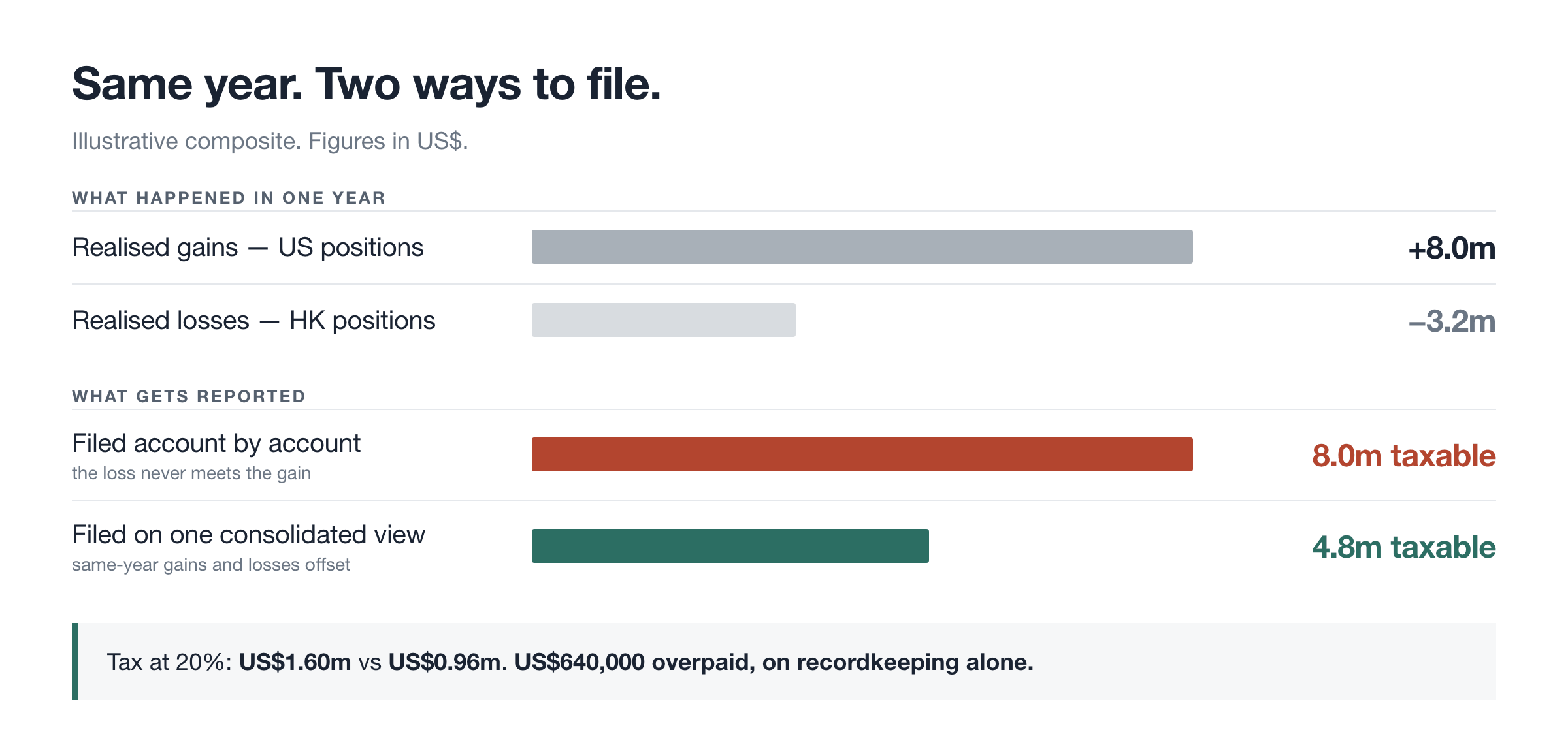
Consolidating is what lowers the base. No legal argument required. You just have to be able to see one year, one category, one taxpayer, across everything.
One timing quirk: the offset only helps from 2026 onward. It does nothing for historical income reported inside the 90-day window, where anything arising before January 1, 2026 goes in as “interest, dividends and bonuses” with no split by category.
Case 02 — The tuition payment nobody called a distribution
Second family. The parents hold Singapore status and settled the trust. Their daughter is a Chinese tax resident, studying in the US. Because the trust was funded by non-residents, the taxing event is the distribution, and the taxpayer is the daughter.
Three things happen every year, and none of them looks like a distribution. The trust pays her tuition straight to the university. She lives rent-free in a flat owned by one of the underlying companies. A loan went out to her in 2024 and was never repaid. All three count as deemed distributions.
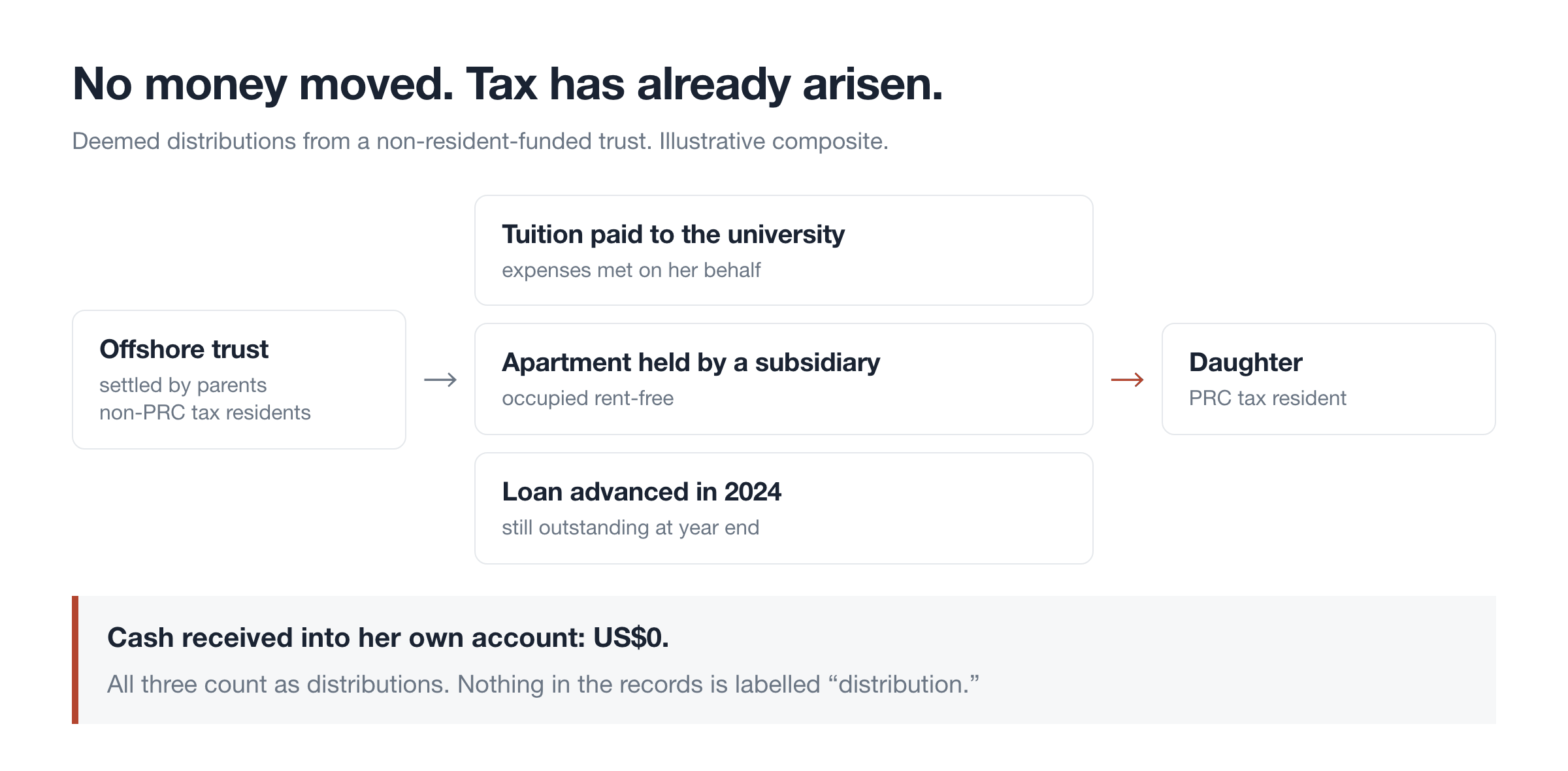
The example assumes she is not also a taxpayer somewhere else. If she were — a US person, for instance — a second set of rules would apply on top, and the analysis changes.
This family is hiding nothing. They didn’t know any of it counted, and almost nobody did. But look at where the evidence lives: trustee payment instructions, bank flows in an underlying company, a loan balance nobody has looked at since 2024. Nothing in any of those records is labelled “distribution.” You find them by putting the trust and everything under it on one view of cash movement, then asking of each flow: who ended up better off?
Case 03 — Tax already paid, but not provable
Foreign taxes that are individual income tax in character can be credited, and most portfolios are full of them. But the credit is capped country by country and category by category, and it turns on having the payment evidence — which sits in dozens of monthly statements never designed to be added together. Without that summary, the credit isn’t reduced. It’s abandoned.
The tax was already paid. The only thing missing is the record that proves it.
Case 04 — A deduction is worth what you can evidence
Back to the question that stopped the room.
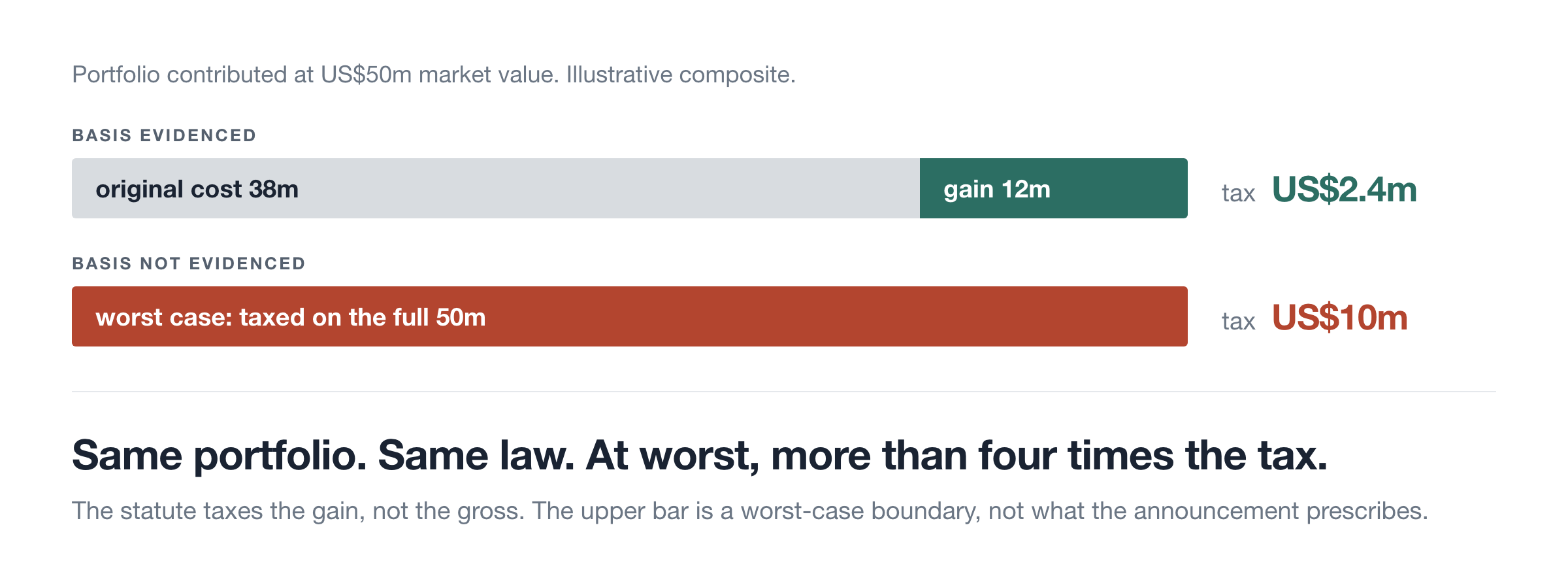
The statute taxes market value less original cost less reasonable expenses. It’s on your side: you’re taxed on the gain, not the gross. But if you can’t evidence the cost, the number stops being yours to determine. The authority can refer the valuation to a government pricing and certification body.
The announcement doesn’t say that failing to evidence cost means tax on the gross. The upper figure is a worst-case boundary, there to show the range.
6. What a complete set of books actually buys you
The first thing a complete set of books gives you isn’t a filing. It’s a view.
Right now, what you know about your own structure is almost certainly in pieces. Positions at one bank you know; for the other you ask the relationship manager. The underlying company’s cash flows sit with the accountant. That 2023 transfer might be in somebody’s inbox. This isn’t bad administration — assets spread across banks, entities and years never had a single view, because nothing was built to give them one.
Put it all on one sheet and three things change:
- You find out what order of magnitude you’re dealing with. That’s what tells you whether this goes to the top of the list or sits further down, and the honest answer differs a lot from one family to the next.
- The conversation with your advisors changes from “find me the records” to “make the call.” The first is billed by the hour. The second is what you’re paying them for.
- You build it once. After that it’s maintenance, not a reassembly job every October.
Being on top of this doesn’t mean having no exposure. It means knowing where you stand.
Here’s what to pull together. Not to file — to hand to your advisor:
- Every entity in the structure on one chart, dormant intermediate holding companies included
- Position-level history from January 1, 2023 with acquisition cost, across every custodian
- Cash flows at trust and underlying entity level, not just beneficiary accounts
- Withholding and foreign tax paid, tagged by country and category, with evidence
- Year-by-year P&L split into the two statutory categories, with the FX rate and conversion date you used — the tax is computed in RMB, whatever currency you report in
- Valuations for anything not listed: private equity, funds, real property, operating companies
- Any loan, guarantee, expense payment or use of property that touches a beneficiary
- Confirmation that the trust deed permits disclosure to you and your advisors, and that the trustee will cooperate — some deeds don’t, and some trustees will want an indemnity first
- The evidence on assets, income and residence that supports your tax residency position
Announcement No. 15 also asks for the annual report covering the year the trust was set up and for 2025, plus historical financial statements. How far back you need to go is a question for your tax advisor.
7. Start with the custodians, not with yourself
One practical point that decides whether October is achievable. The long pole isn’t your team. It’s the banks. Historical statements typically take four to eight weeks to arrive once requested, and some custodians won’t go back more than a couple of years without an escalation.
Which means the request goes out this week, before anyone has finished tidying anything internally. Everything else can be done in parallel. That one cannot.
And this repeats. Annual attribution makes the trust a standing annual filing: the prior year, between March 1 and June 30, same evidence every time. What your advisors do this autumn is the first turn of it, not a one-off scramble.
As for whether that four months can be compressed: this is the part we do.
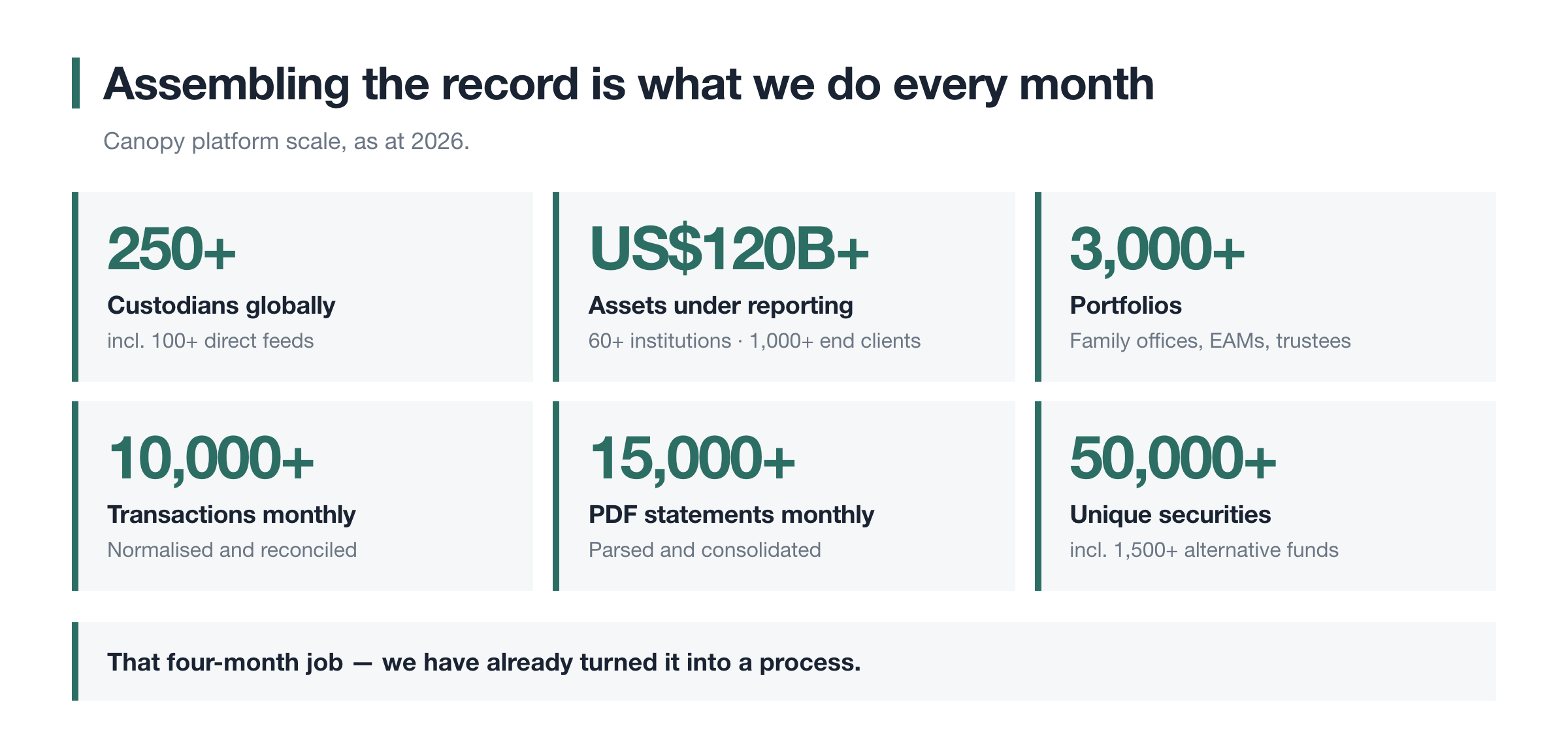
The two numbers in the middle are the ones worth pausing on. 15,000 PDF statements parsed and 10,000 transactions normalised and reconciled, every month. A family’s historical data exists in precisely those two forms.
Turning it into a ledger a tax advisor can work from takes three steps. Collect positions and flows from every bank and every underlying entity, feed or PDF. Normalise them onto one format, because every institution names the same asset differently. Reconcile each line back to the custodian’s own record, and flag what doesn’t tie instead of plugging a number.
That last step isn’t fully automated, and we don’t pretend otherwise. AI parses and matches; people review the exceptions. For anything that has to survive being questioned, you can’t skip it. Alternative funds and structured products are in scope too.
Canopy is an AI-native wealth platform that aggregates data across custodians for external asset managers, family offices and UHNW families: 250+ custodians globally, including 100+ direct feeds, over US$120bn in assets under reporting, and source-linked drill-down to the underlying records. We work alongside law firms, tax practices and trustees. We build the data layer; they make the calls.
Coco Lai spent four years in private banking at J.P. Morgan and is a CFA charterholder. She now leads business development for Canopy in Hong Kong, and writes about the unglamorous half of wealth management — data, reporting, and the operational plumbing nobody thinks about until something goes wrong.
Coco is an employee of Canopy. Views are her own.
This article is for general information only. It is not tax or legal advice, and Canopy does not provide tax opinions. Offshore trust taxation turns heavily on individual facts. Please consult a qualified tax advisor or lawyer on your own position.
Sources
Official
- MOF / STA Announcement No. 21 of 2026, on individual income tax matters concerning offshore trusts (July 24, 2026)
- STA Announcement No. 15 of 2026, on tax administration for offshore trusts, and the official interpretation
- MOF Tax Policy Department and STA Income Tax Department — press Q&A
- Xinhua — two ministries clarify individual income tax on offshore trusts
Professional commentary
- Han Kun — New IIT rules for offshore trusts: the 90-day window matters
- King & Wood Mallesons — New IIT rules for offshore trusts
- JunHe — Key points of the new offshore trust IIT rules
- AllBright — Three gates, six sets of rules, four categories of taxpayer
- PwC China Tax News — Interpreting the offshore trust IIT rules
- KPMG China Tax Alert — New IIT Rules for Offshore Trusts
- Morgan Lewis — China Establishes New Individual Income Tax Rules for Offshore Trusts